Why “Pluto”
Just like Pluto (the celestial body) is a Dwarf Planet, the PlutoSDR is an active learning module resembling a software defined radio, but it lacks some performance/technical criteria for classification as such. While it serves as a great learning tool for communications or SDR classes, the PlutoSDR is not meant as a replacement for professional Software Defined Radios. It was designed to provide RF/SDR functionality for students at an affordable price point; as a result, there are limitations users should understand.
System Issues
Temperature Range
The PlutoSDR has been tested in the range “10°C to 40°C. While this is nominal for classrooms world wide - it is not robust enough for units to be used in a commercial setting.” Devices inside typically specify 0°C to 70°C or −40°C to +85°C. This limitation stems from system-level design, casing, and qualification scope. Higher performance requires additional verification.
Digital Issues
USB 2.0
USB 2.0 operates at 480 Mb/s half-duplex:
At 100% utilization: 60 MB/s theoretical
Protocol overhead (~10-15%): reduces to ~50 MB/s
Control/interrupt/isochronous transfers (~10%): reduces to ~45 MB/s
Half-duplex split: ~22.5 MB/s each direction
12-bit samples (2 bytes): ~11 MSPS theoretical
Actual PlutoSDR performance: 7.5 – 12 MSPS, roughly 65–100% of theoretical rates. This depends heavily on USB host and concurrent traffic. Faster interfaces (Gigabit/10G Ethernet, USB 3.0, PCIe) exist in commercial offerings.
The PlutoSDR includes 512 MB internal memory enabling burst mode operations. Example: 128 MB (32 MSamples) at 30.72 MSPS (LTE20) stores 1.04166 seconds of RF data—approximately 104 LTE frames—sufficient for educational decoders.
FPGA Size
The Xilinx Zynq 7010 FPGA is quite limited:
Attribute |
Size |
|---|---|
Logic Cells |
28 K |
Block RAM |
2.1 Mb |
DSP Slices |
80 |
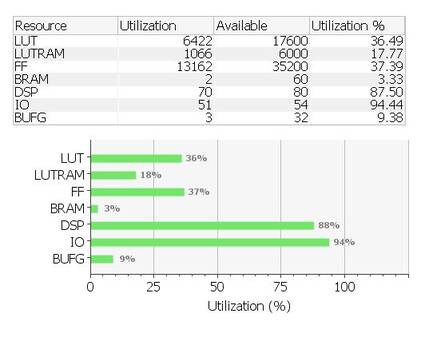
The default design uses FPGA resources for:
CMOS interface implementation
I/Q rotation (optional)
DDS (multi-tone transmit generation)
8x interpolation/decimation (enables sample rates as low as 65.104166 kSPS versus AD9363 minimum 520.833 kSPS)
Typical utilization includes: 40 DSP slices for additional decimation/interpolation filters (20 each), 20 for optional DDS, 2 per channel for optional 2×2 matrix multiply (IQ correction/phase rotation), and 1 per channel for DC filtering. Users not requiring these features can disable them for custom logic. Larger performance requirements necessitate upgrading to larger Zynq devices, impacting size and cost.
RF Issues
Oscillator
The PlutoSDR uses a Rakon RXO3225M 40.000 MHz oscillator (Custom PN: 509336) meeting AD936x jitter requirements. Frequency stability is ±25 ppm (voltage, temperature, drift plus initial accuracy).
While seemingly problematic, this is addressable through:
Digital correction by programming XO frequency to measured values (Hz resolution), updating LO and sample rates accordingly
Standard receiver frequency compensation algorithms—most systems accommodate transmitter/receiver frequency mismatches
Loopback testing—offsets match between transmit/receive channels on a single device (random phase differences remain between LOs)
Alternative oscillators can overcome this limitation at potential cost impact.
Tuning Range
The AD9363 tuning range spans 325–3800 MHz LO center frequencies—over one decade covering many interesting bands in the US, Europe, Australia, and Japan. However, this is narrower than the AD9361 or AD9364 which span 70–6000 MHz (nearly two decades).
Upgrading involves swapping to AD9364 or AD9361—pinouts are nearly identical but cost increases. Some users report success telling the PlutoSDR it contains an AD9364.
RF Shielding
The PlutoSDR lacks internal RF shielding. Strong transmitters (e.g., cellphones) placed nearby may degrade performance at any tuned frequency. Adding RF shielding would impact cost and size.
RF Filtering
There are no preselect or output filters. The AD9363 output directly feeds the SMA connector; antenna input directly feeds the AD9363 pins.
The AD9363 RF transmitter outputs moderate 3rd harmonic distortion. At 3 GHz, the 3rd harmonic (9 GHz) falls outside the balun range. At 500 MHz, the 3rd harmonic (1500 MHz) remains within range—a 500 MHz transmission inadvertently broadcasts at 1500 MHz as well.
Adding specific preselect/output filters complicates design based on desired tuning range and antenna selection. (Antennas function as filters themselves.)
RF Performance
The AD9363 RF performance is adequate for many applications but does not match higher-performance devices like the AD9361, AD9364, or AD9371 found in commercial SDR offerings. The PlutoSDR exceeds performance of many same-class devices and datasheet specifications in testing, but is not designed as the best possible SDR.